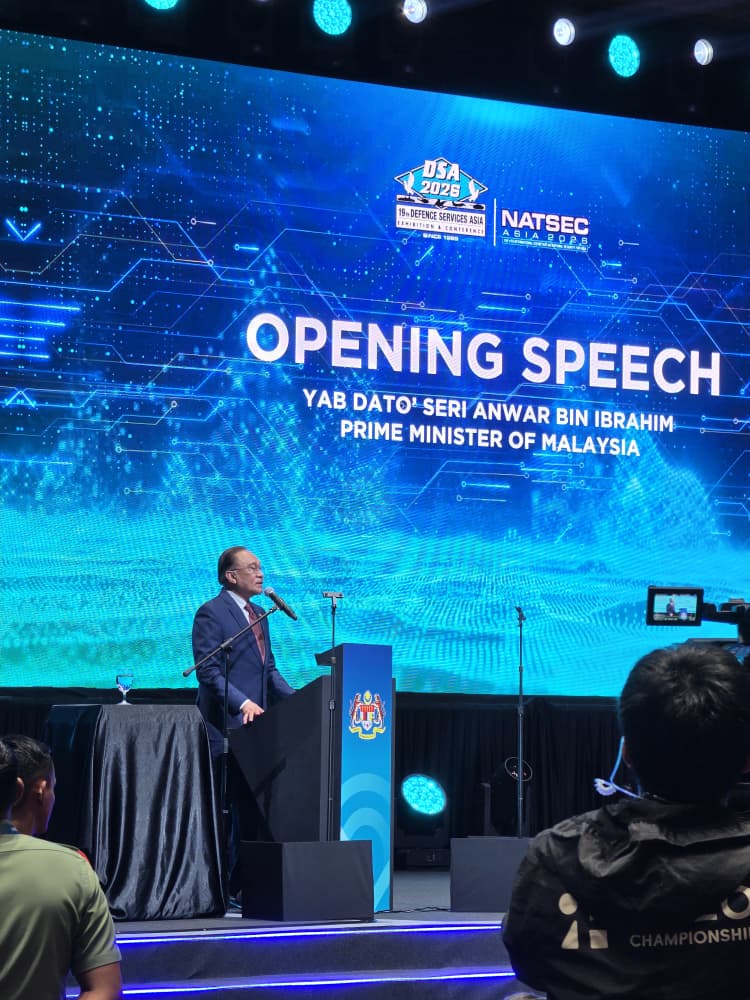
KUALA LUMPUR, Apr 20 – Malaysia’s active non-alignment policy allows it to maintain working relationships across all major partners, even amid global uncertainty, Prime Minister Datuk Seri Anwar Ibrahim said today.
He said the approach draws interest for defence partnerships and investments in his speech at the opening ceremony of the Defence Services Asia (DSA) and National Security Asia (NATSEC) 2026 exhibition and conference.
“A Malaysian supplier enters your supply chain without the political complications that have made sourcing decisions so difficult elsewhere. In the current environment, that is a genuine commercial consideration,” he added.
Anwar said the government is building a defence industrial base where Malaysian companies earn and maintain their place in international supply chains based on performance and strength.
“That is the only foundation worth building on,” he said.
The prime minister urged defence and aerospace companies to engage with Malaysian manufacturers, saying they already operate within demanding global supply chains.
He also said local companies manufacture wing structures for some of the world’s most widely flown commercial aircraft, as well as precision components for aero-engines used across long-haul routes.
“Semiconductor plants in Penang and Kulim handle assembly, testing and packaging for chips embedded in defence and security systems,” he said.
Anwar said Malaysia makes things the world depends on, noting that companies have delivered consistently in demanding global supply chains.
“They have seen a government that follows through on what it commits to. They have seen an economy that held its ground while conditions around it deteriorated. And they have seen something that Malaysians ourselves do not say often enough: that this country makes things the world genuinely depends on,” he said.
He said the meeting comes at a moment when geopolitics is reshaping supply chain decisions as profoundly as cost or engineering capability ever did.
Despite this, in recent weeks global funds bought over two billion dollars in Malaysian bonds, while the ringgit has been Asia’s best-performing currency for two consecutive years, Anwar said, adding that the economy grew 5.2 per cent last year.